Regulatory Scope and Framework Boundaries
Navigating workplace document accessibility requires understanding that statutory payroll rights and digital publishing guidelines operate within distinct institutional frameworks across jurisdictions. GOV.UK describes payslip information and entitlement in a UK context, including exceptions; it does not establish a worldwide accessibility law. [S3] WCAG includes normative success criteria, while the PDF techniques discussed here illustrate possible implementations rather than an exclusive prescribed method. [S1][S2][S4][S5] Establishing clear internal compliance baselines necessitates separating general accessibility principles from specific legal requirements governing payroll information dissemination.
When evaluating electronic payslip accessibility, administrative teams must recognize that digital standards evolve continuously while statutory payroll obligations remain tied to specific national legislation. The UK guidance describes earnings before and after deductions, variable deductions, and hours where pay varies with time worked; fixed deductions have separate explanation provisions. [S3] Consequently, digital document authors cannot rely on automated publishing tools to guarantee complete regulatory alignment from the export operation alone. Establishing internal review procedures can help teams examine disclosures and accessibility together, while recording which requirements apply in their particular jurisdiction.
Document Structure and Reading Order Fundamentals
Document structure provides an architectural layer for assistive technologies interpreting financial tables and earnings summaries. W3C PDF3 explains checking and repairing the reading sequence in a tagged PDF, including layouts whose visual columns do not match their tag order. [S2] When authoring digital payroll statements, a logical flow helps readers follow how identification numbers, tax codes, and gross amounts relate to one another. Reviewers can compare the visual presentation with the structural reading sequence and test the intended relationships using assistive technology.
Maintaining a correct reading sequence involves checking the exported document; manipulation of structural tags is one possible repair rather than an intervention every export needs. PDF3 notes that conversion of complex layouts may need subsequent repair; it does not establish that every exporter fails or requires the same intervention. [S2] Without rigorous quality assurance checks, screen readers may process statutory deduction rows before primary earnings figures, making their relationship harder to follow. This article proposes implementing systematic testing protocols to inspect underlying structural trees before publishing electronic statements to active workforce portals.
Tabular Data Relationships and Cell Associations
Financial statements rely heavily on tabular layouts to communicate earnings, deductions, and cumulative year-to-date totals in a compact visual form. W3C PDF6 illustrates Table, TR, TH and TD structure so tabular relationships are available beyond visual positioning alone. [S4] If those relationships are absent, a review should ask whether a reader can still connect each number with its payment category. A proposed review checks each data cell against its intended header rather than relying solely on visual borders or alignment.
Implementing robust table accessibility demands meticulous configuration of table header elements and data cell attributes during document compilation. The technique provides an example of correctly structured table tags and a procedure for examining the resulting table relationships. [S4] A conversion that flattens a table into unrelated text boxes is a useful hypothetical failure case, not a measured claim about payroll exporters. Document engineering teams can audit generated outputs against recognized technical specifications to check whether tabular hierarchies remain available in the exported document.
Heading Hierarchies and Document Navigation
Effective document navigation relies on consistent heading hierarchies that partition complex payslips into digestible informational sections for readers using different navigation methods. W3C PDF9 illustrates heading tags as a means of exposing document organization to assistive technology. [S5] A useful review question is whether the heading outline communicates the intended section relationships to someone navigating without scanning the page visually. Designers can use a logical hierarchy for primary titles and subsections, without treating this example as a universal rule that every document has identical heading levels.
Proper heading implementation transforms lengthy payroll documents into structured interfaces where users can quickly locate specific financial details without exhaustive reading. PDF9 describes navigation by headings; applying that technique to earnings sections or tax summaries is an editorial design proposal. [S5] Editorial teams should avoid styling plain text paragraphs to look like headings without applying underlying semantic tags. Inspection can compare visual titles with the tag structure and record any discrepancy; heading tags alone do not establish a seamless experience.
Gross, Net, and Period Relationship Explanations
Transparent payslip design requires clear articulation of the mathematical and chronological relationships connecting gross earnings, deductions, and final net disbursement amounts. Explanatory text accompanying payment summaries can outline how tax periods correspond to actual disbursement dates without offering formal financial or legal counseling. Employees benefit from concise contextual notes that clarify how cumulative year-to-date figures accumulate across successive pay cycles. A proposed editorial approach presents these structural relationships in plain language to foster workforce trust and administrative clarity.
Detailing earnings components effectively involves breaking down complex statutory contributions alongside voluntary deductions in a standardized, predictable sequence. One proposed layout organizes line items so that gross remuneration appears first, followed by itemized deductions and final take-home pay. Whether that layout improves comprehension or changes inquiry volume would require reader research; no such outcome is reported here. Employers should design explanatory footnotes that demystify unfamiliar deduction acronyms with the applicable disclosure rules assessed separately for the relevant jurisdiction.
Proposed Document Testing and Verification Workflows
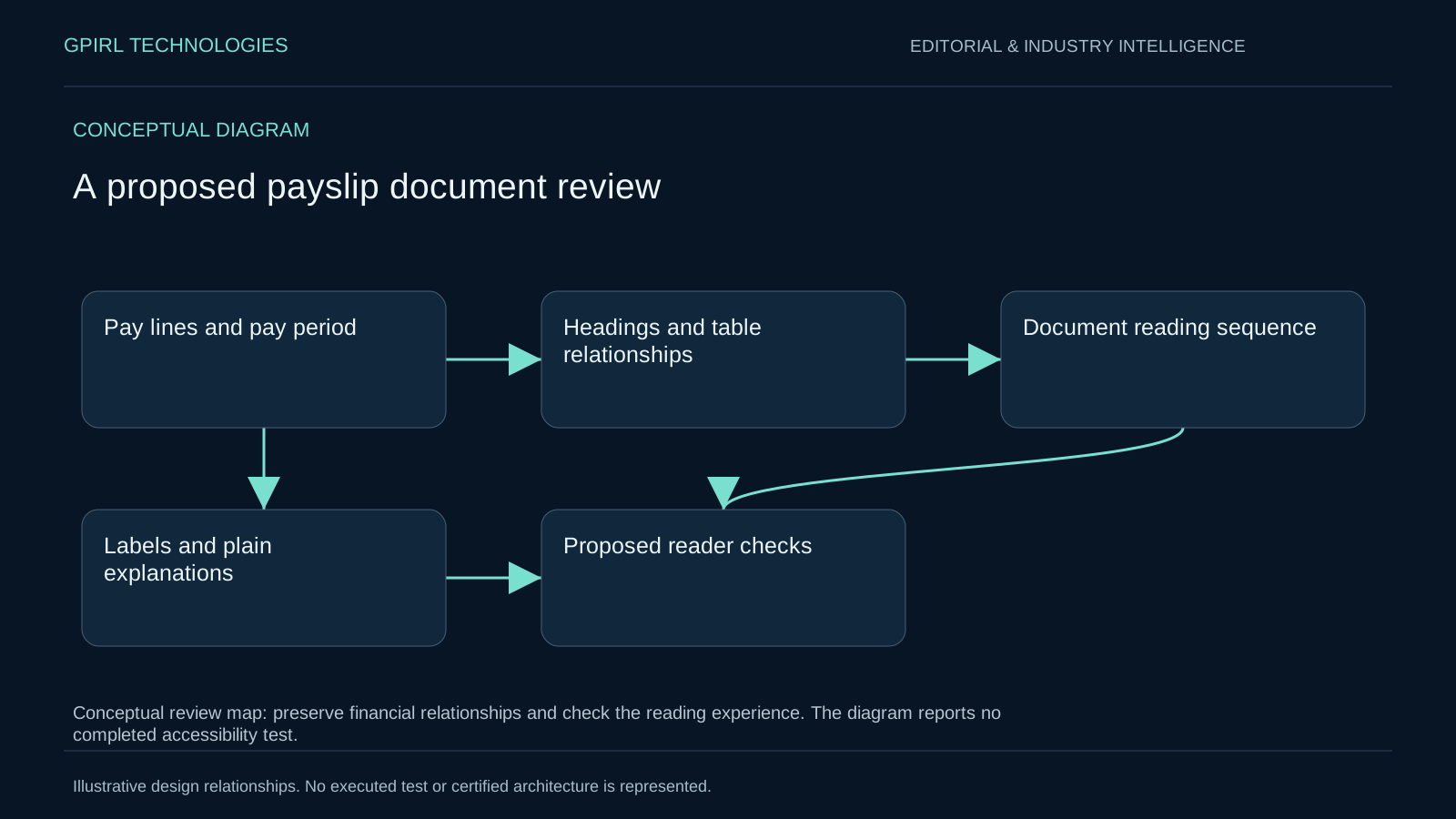
Establishing dependable accessibility testing workflows requires combining automated validation tools with planned human evaluation before document distribution. Automated checks may flag structural issues, but a successful check does not establish whether an employee understands the financial relationships in the document. In a proposed synthetic scenario, reviewers would navigate a fictional payslip using keyboard-only commands and screen-reading software to evaluate real-world usability from an accessibility perspective. The fictional document would contain a gross-pay table, deduction rows and a net total; the exercise has not been run and uses no employee records.
Verification protocols should incorporate structured testing matrices that evaluate payslip accessibility against established technical guidelines without claiming absolute legal compliance certification. Document teams can document testing outcomes systematically, tracking remediation efforts for any structural errors discovered during evaluation phases. Creating feedback channels for employees encountering accessibility barriers provides another input to reviewing document authoring practices. Results would show which questions were answered for that document and which remain unresolved, without conferring certification on every template or future export.
Informative Examples Versus Mandatory Implementations
WCAG requirements and informative techniques have different roles: the techniques offer implementation examples and are not the sole means of meeting the applicable success criteria. [S1][S2][S4][S5] Organizations retain flexibility in choosing how to structure their digital documents provided the final output meets core accessibility and transparency objectives. Treating informative code snippets or layout examples as absolute legal mandates can distract reviewers from evaluating the intended accessibility outcome. Document architects can evaluate technical recommendations critically, adapting them to fit their specific enterprise software environments.
Distinguishing between mandatory statutory requirements and informative technical examples helps teams explain why a proposed software modification is needed. Regulatory authorities outline what information must be communicated to workers, while technical specifications suggest methods for achieving programmatic accessibility. By focusing on core functional outcomes such as logical reading order and clear table associations, development teams can define what their review is intended to establish. The same distinction remains useful as digital standards and workforce communication platforms continue to evolve.
Continuous Improvement and Governance in Payroll Publishing
Sustaining high accessibility standards in payroll document publishing requires ongoing governance structures that monitor software updates and authoring practices. Enterprise policies should designate clear responsibilities for reviewing document templates whenever payroll management systems undergo major version upgrades or vendor migrations. Regular internal reviews can look for structural inconsistencies before electronic payslips reach active employee portals. Fostering cross-functional collaboration between HR, IT, and compliance teams can keep accessibility visible as an integral component of workforce operations.
The ultimate goal of accessible payslip authoring is to deliver transparent, comprehensible financial data to every worker while making any remaining barriers visible for further review. Organizations that invest in robust document structures can make their intended reading experience more explicit and open to scrutiny. As digital workplace standards mature, proactive document governance can continue to support effective workforce communication. These structured authoring principles offer questions to revisit each pay cycle; they do not prove compliance or an improvement in employee trust.
Official background videos
External publisher context. These recordings do not demonstrate GPIRL products or validate the proposed designs.
- Web Accessibility Perspectives: Clear Layout and Design
Official W3C background on clear structure, headings and consistent presentation, relevant to a payslip's document organization. It is not a payroll-specific implementation or a complete PDF/WCAG conformance test.
Sources and further reading
- [S1] Web Content Accessibility Guidelines 2.2
- [S2] W3C PDF3: Ensuring correct tab and reading order
- [S3] GOV.UK Payslips: employee rights
- [S4] W3C PDF6: Using table elements
- [S5] W3C PDF9: Providing headings
References do not imply product certification or endorsement.
Have a related operational question? Discuss an unresolved evidence question in your operating context with GPIRL Technologies.