Introduction: The Container Boundary in AI Infrastructure
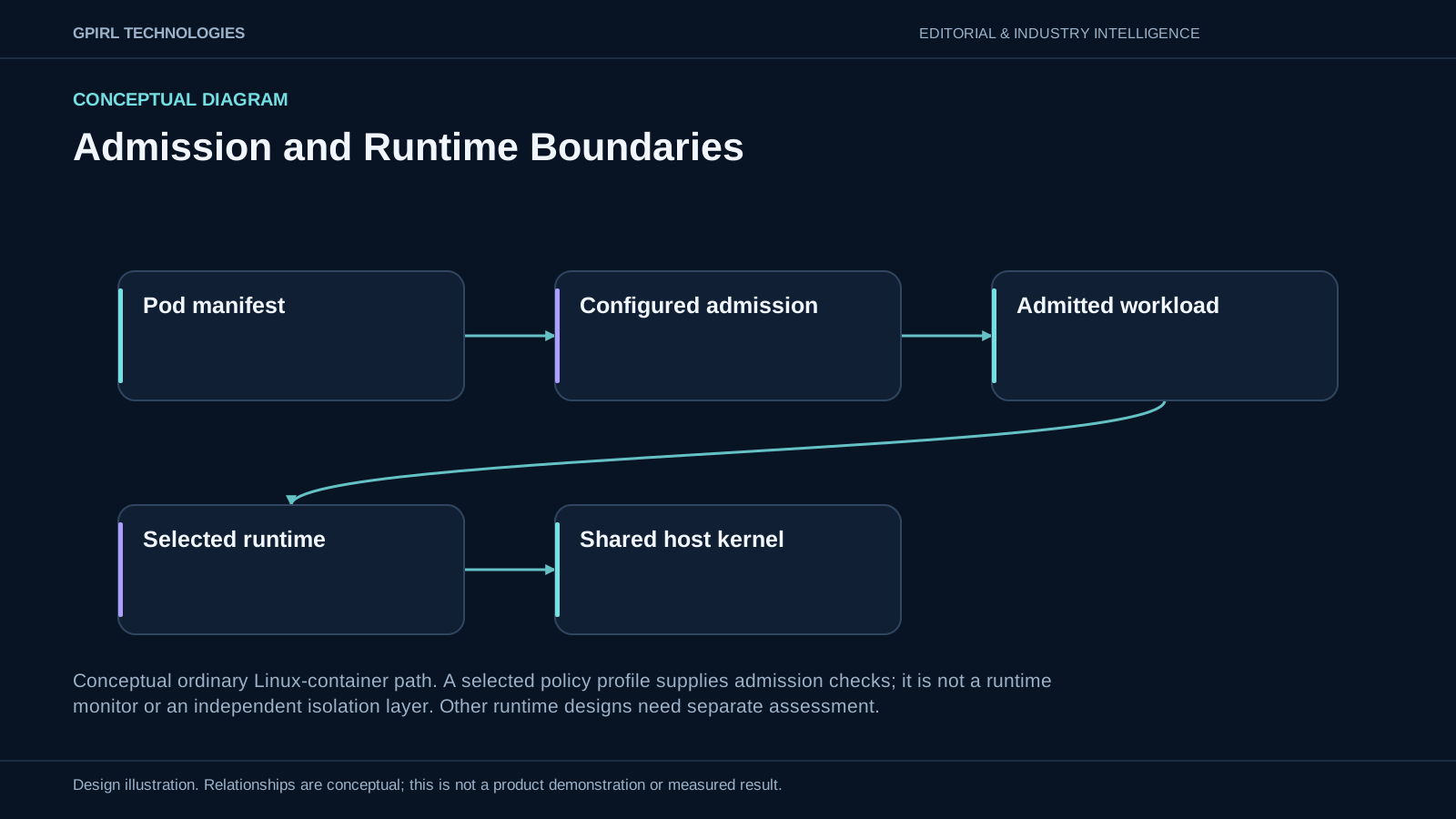
This article considers ordinary process-isolated Linux containers used for AI workloads. It does not estimate adoption, establish the default configuration of every runtime or treat VM-backed and sandboxed runtimes as identical. NIST SP 800-190 provides container-security context rather than a current study of AI or GPU deployments [S2]. However, containers differ fundamentally from virtual machines because they rely on shared host operating system kernels and process namespacing rather than hardware hypervisor virtualization [S2]. This architectural distinction creates significant security considerations for platform engineers managing heavy AI compute tasks [S1] [S2].
Assuming that standard container packaging provides absolute isolation for high-risk workloads is a persistent misconception in cloud-native engineering [S2]. Ordinary Linux containers use host operating-system mechanisms for process and resource separation, but their configuration does not eliminate shared-kernel exposure [S2]. Understanding precisely what the container boundary protects—and where its limitations lie—is vital for platform teams designing robust security postures [S1] [S2]. Hardening can reduce selected risks, but residual exposure depends on the host, runtime, workload, configuration and threat model. A review should identify those assumptions and the evidence still needed; a configuration label is not a guarantee against privilege escalation or host compromise [S1] [S2].
Threat Models and Shared Kernel Realities in NIST SP 800-190
Guidance provided by the National Institute of Standards and Technology in Special Publication 800-190 systematically categorizes application container security threats across enterprise environments [S2]. The publication emphasizes that containers share the host operating system kernel, making that kernel an important attack surface for containers sharing the host. Other nodes, VM-backed runtimes and sandbox boundaries require their own analysis [S2]. Threat models outlined in the guide highlight risks associated with insecure image registries, misconfigured orchestrators, and compromised runtime engines that could allow malicious code to impact host integrity [S2].
Mitigating these shared kernel risks requires implementing comprehensive security controls across the entire container lifecycle, from initial image creation to active execution [S2]. NIST recommendations stress that container isolation mechanisms are not foolproof and must be supplemented by strict principle-of-least-privilege configurations [S2]. Platform architects must evaluate host operating system hardening and kernel security modules to establish reliable defense-in-depth strategies for demanding enterprise workloads [S2]. Recognizing these baseline threat realities prevents organizations from relying solely on default container boundaries for security [S2].
Kubernetes Pod Security Standards: The Restricted Policy Baseline
Kubernetes documents Privileged, Baseline and Restricted policy profiles. The definition of a profile is distinct from the mechanism and mode used to enforce it; applicable controls also have version and operating-system conditions [S1]. Crucially, the Restricted standard does not mandate a read-only root filesystem by default, leaving that specific control as an optional hardening measure for administrators to configure based on application requirements [S1]. The absence of that particular requirement does not establish application compatibility: non-root execution, permitted volume types and other configured controls can still require changes to a workload [S1].
Operating within the Restricted policy level requires workloads to adhere to the applicable constraints on volume types, security-context settings and user execution parameters for the selected policy version and operating system [S1]. Pods must run as non-root users and prohibit privilege escalation vectors that could allow processes to gain elevated operating system privileges [S1]. While these standards establish robust baseline configurations for modern clusters, they represent admission policies rather than active runtime intrusion prevention systems [S1]. Understanding the exact scope of Pod Security Standards ensures that platform engineers configure admission controllers accurately without making unsupported safety assumptions [S1].
Capability Dropping and the NET_BIND_SERVICE Exception
A core security requirement of the Kubernetes Restricted Pod Security Standard is the mandatory dropping of all Linux capabilities for container processes [S1]. The reviewed PSS fact is the allowed capability configuration, not a complete assessment of every permission retained by the workload. A review should keep that configuration check distinct from filesystem access, resource limits and other parts of the threat model. For applicable Restricted Linux workloads, NET_BIND_SERVICE is the only capability permitted to be added back [S1]. That allowance does not mean every application needs it. The operator should document the application requirement and assess its runtime behavior separately rather than add it merely because the profile permits it.
This targeted exception illustrates the nuanced design of modern container security policies, balancing strict privilege reduction with practical networking requirements for enterprise applications [S1]. Platform administrators must verify that container runtimes and operating system versions correctly enforce capability drops and exceptions across cluster nodes [S1]. Relying on capability restrictions without validating underlying kernel support can leave security gaps in multi-tenant environments [S1]. Properly managing Linux capabilities is an essential component of comprehensive workload hardening in Kubernetes clusters [S1].
Synthetic Scenario: Hardening Multi-Tenant Inference Workloads
Consider a synthetic enterprise scenario where a cloud platform hosts multi-tenant model inference workloads for various external business clients on a shared Kubernetes cluster [S1] [S2]. The proposed operator configures admission enforcement for a selected Restricted profile version in the relevant tenant namespaces to reduce specified configuration risks [S1]. In this synthetic deployment, admission controllers automatically evaluate pod manifests upon creation, rejecting any workload attempting to run as root or failing to drop required Linux capabilities [S1].
During routine operations, a tenant attempts to deploy an unhardened inference container configured with privileged escalation flags and unnecessary host volume mounts [S1]. In the proposed test, the expected outcome would be admission rejection of the disallowed settings. That expected outcome must be checked against the chosen policy version and configuration; no test was run here. This example separates admission checks from observation of behavior after a pod has started [S1] [S2]. The scenario underscores the necessity of combining admission policies with runtime observation [S1] [S2].
Admission Control Versus Active Runtime Detection and Auditing
Platform engineers must maintain a clear distinction between admission policy enforcement and active runtime security monitoring in containerized environments [S1] [S2]. Admission controllers evaluate pod configurations at the moment of creation, accepting or rejecting manifests based on predefined security standards [S1]. However, admission policies cannot detect unauthorized process execution, file tampering, or network anomalies that occur after a container has started running successfully [S1] [S2]. A separate runtime assessment could examine process, file or network behavior according to the threat model. Choosing an observer does not itself establish prevention, complete detection or a safe response.
Combining admission control with runtime observation is a proposed defense-in-depth approach that addresses distinct questions about deployment configuration and later behavior [S1] [S2]. Auditing pod security warnings in non-production namespaces allows engineering teams to identify non-compliant workloads before enforcing strict rejection rules in production [S1]. A staged review can reveal some policy conflicts before enforcement, but it does not prove that migration will be disruption-free. Operators still need a tested response to rejected workloads and unexpected runtime behavior. Recognizing the division of labor between admission and runtime layers is essential for effective cloud security engineering [S1] [S2].
Technical Limits, Performance Tradeoffs, and Cluster Resilience
Securing artificial intelligence workloads through strict container isolation introduces notable technical limits and operational tradeoffs that organizations must evaluate [S1] [S2]. Enforcing restricted security contexts and dropping capabilities can occasionally interfere with specialized machine learning libraries that require specific hardware device access or low-level system interactions [S1]. Furthermore, runtime monitoring may consume CPU, memory or other resources. The effect should be measured for the selected monitor and workload rather than assumed from a general security guide. No GPU performance result or universal overhead figure is reported here.
Container isolation mechanisms provide vital layers of defense, but they do not eliminate all risks associated with kernel vulnerabilities or sophisticated container breakout exploits [S1] [S2]. Some threat models may justify evaluating VM-backed or sandboxed runtimes and additional host controls. The choice needs evidence about the specific isolation mechanism, remaining shared components and operational requirements; this article does not establish one mandatory architecture for all sensitive data. Engineering leaders must adopt a pragmatic perspective, recognizing that container boundaries are one component of a multi-layered security architecture rather than an impenetrable shield [S1] [S2]. The practical decision is which threats the selected controls address, which they leave open and how their behavior will be verified before scope expands.
Official background videos
External publisher context. These recordings do not demonstrate GPIRL products or validate the proposed designs.
- National Institute of Standards and Technology — The NIST Cybersecurity Framework (CSF) 2.0
Cybersecurity risk-management background for discussing container threat boundaries; the video does not establish isolation or Kubernetes enforcement.
Sources and further reading
References do not imply product certification or endorsement.
Have a related operational question? Bring this question to a GPIRL Technologies discovery discussion.