Operational Roles of OPC UA and MQTT
Industrial IoT architectures frequently integrate multiple protocol standards to bridge factory floor operations with enterprise IT networks. A recurring source of design confusion is treating OPC UA and MQTT as identical solutions competing for the same task. This view neglects fundamental architectural differences between rich object-oriented information modeling and transport-layer message broker systems.
OPC UA is a comprehensive framework that includes information models, operational services, security profiles, and underlying communication protocols [S1]. MQTT is a lightweight, payload-agnostic publish/subscribe messaging transport protocol [S2]. Understanding that OPC UA defines data structure and semantic context while MQTT provides efficient message routing allows systems engineers to combine both technology stacks effectively.
OPC UA Part 14 and MQTT Integration
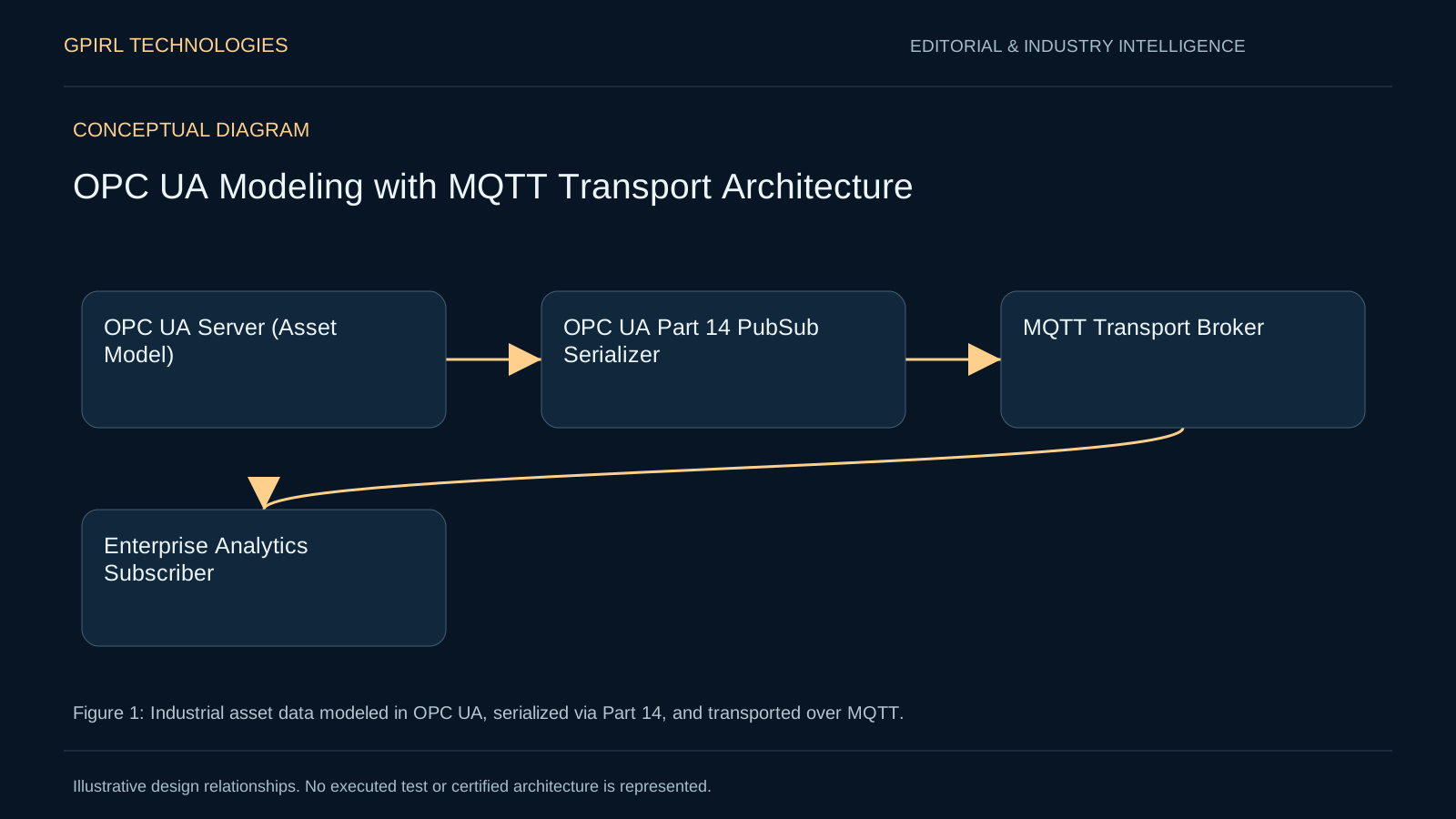
The OPC UA specification explicitly addresses pub/sub architectures in Part 14, establishing standard mappings for transmitting OPC UA structures over transport layers such as MQTT [S1]. Rather than replacing OPC UA, MQTT serves as a transport option for publishing OPC UA encoded payloads [S1] [S2].
OPC UA Part 14 defines how complex data nodes, structure metadata, and status codes are encoded into binary or JSON formats and published to MQTT topic hierarchies [S1] [S2]. MQTT brokers route these payloads efficiently without needing to inspect or understand the underlying industrial data structures [S2]. This standardized integration combines OPC UA semantic modeling with MQTT pub/sub distribution.
Information Models vs Opaque Payloads
A key distinction between the two technologies lies in how data attributes and metadata are handled. OPC UA Variable nodes have defined attributes such as DataType and AccessLevel. EngineeringUnits is a Property of applicable Data Access types; it is not automatically present on every node [S3]. A client can browse and read the metadata exposed by a server, subject to the model and permissions; the selected Part 14 MQTT mapping does not itself define the complete AddressSpace [S3].
By contrast, MQTT standardizes message packet delivery, topic routing, Quality of Service levels, and connection keep-alive mechanisms, but treats the message payload as an opaque byte array [S2]. An MQTT broker routes payloads regardless of whether they contain JSON, XML, or raw binary data [S2]. Consequently, applications receiving raw MQTT messages rely on out-of-band schema definitions to interpret variable meanings.
Synthetic Industrial Architecture Design
Consider a synthetic industrial plant featuring a multi-stage compressor equipped with temperature, pressure, and vibration sensors. In an OPC UA client-server setup, an OPC UA server exposes these parameters as structured object nodes. A client reading the pressure node would check that an applicable EngineeringUnits Property is exposed and confirms the assumed kilopascal unit before using the reading in an independently assessed workflow [S3].
To distribute this telemetry to enterprise analytics, the site implements OPC UA Part 14 PubSub over MQTT [S1] [S2]. The proposed gateway would publish configured OPC UA PubSub messages over MQTT. Whether values, status and required metadata are available to a subscriber depends on message masks, encoding and metadata configuration; publishing a node does not automatically send every Property with every value [S1] [S4].
Failure Investigation: Misinterpreting Transport Guarantees
Failure analyses in enterprise IIoT deployments highlight risks associated with misinterpreting network transport guarantees. In one hypothetical failure scenario, an engineering team relies on MQTT Quality of Service Level 2 (QoS 2) to ensure critical industrial transaction logs are processed exactly once by enterprise database subscribers [S2].
When a database service experiences an internal transaction error, the MQTT broker successfully delivers the network packet, but the end application fails to commit the record. The investigation confirms that MQTT QoS 2 guarantees exactly-once delivery across the network transport layer, not end-to-end application business logic completion [S2]. Mitigating this requires implementing application-level acknowledgments alongside network transport mechanisms.
Decision Records: Evaluating Transport and Modeling Options
Systems architects evaluating plant communications must decide when to use direct OPC UA client-server connections versus OPC UA PubSub over MQTT. Direct client-server sessions provide request-response services, method calls, and session-based security, which may fit local supervisory interactions. Deterministic control timing and safety suitability require separate system-specific analysis. PubSub over MQTT decouples senders and receivers, making it suitable for high-fanout cloud data ingestion [S1] [S2].
An architectural decision record for a multi-site manufacturer might select OPC UA client-server for local cell control and OPC UA PubSub over MQTT for cloud telemetry pipelines [S1] [S2]. This hybrid decision applies each protocol to its intended operational scope, avoiding unnecessary network overhead.
Tradeoffs and Limitations of Integrated Protocols
Combining OPC UA semantic models with MQTT transport introduces design tradeoffs. Transmitting rich metadata structures alongside sensor values increases packet payload sizes compared to minimal binary formats. For bandwidth-constrained remote telemetry links, this additional overhead must be managed carefully.
Furthermore, while OPC UA specifications define standardized metadata mappings [S1], receiving applications must be equipped to parse OPC UA JSON schemas. Utilizing raw MQTT without standardized payload schemas avoids payload overhead but introduces ongoing integration friction when managing custom data formats across enterprise systems [S2].
Practical Architecture Guidelines for Integration
Engineering teams designing industrial data pipelines should begin by modeling asset hierarchies and variable attributes using OPC UA AddressSpace structures [S1]. Step two requires selecting transport protocols based on network topology, using MQTT for scalable, decoupled publish/subscribe distribution [S2].
Step three configures edge serialization formats using OPC UA Part 14 JSON or binary specifications [S1]. Step four establishes topic structures and QoS levels on the MQTT broker [S2]. Step five verifies that downstream subscribers parse both payload data and metadata properties [S1] [S2]. This proposed review creates checks for transport and interpretation; neither protocol selection alone proves data integrity or end-to-end completion.
Proposed Metadata Revision and Late Subscriber Tabletop
To investigate how industrial data pipelines handle unexpected metadata modifications or late-joining subscribers, engineering teams can execute a metadata-revision tabletop exercise. Consider a hypothetical scenario where an edge temperature sensor modifies its internal measurement units from Fahrenheit to Celsius while publishing telemetry over an MQTT broker. A newly reconnected enterprise subscriber consumes the incoming byte stream without accessing the most recent metadata transmission. The tabletop evaluates how the receiving application interprets numerical values lacking explicit context. Participants examine whether MQTT Quality of Service levels ensure correct business interpretation, concluding that network transport delivery guarantees do not prevent semantic misinterpretation of payload data.
The exercise compares three alternative architectural approaches for handling metadata mismatches: dropping incoming payloads until updated metadata arrives, quarantining ambiguous messages for manual inspection, and labeling data streams with an explicit uncertainty flag. Each approach involves operational tradeoffs between data availability and analytical safety. Reviewers analyze the assumption that an EngineeringUnits property is always present in every payload, noting that structured metadata frequently travels separately from lightweight telemetry messages in decoupled publish-subscribe architectures. The discussion emphasizes that no universal architectural prescription fits all plant applications, requiring engineers to evaluate system-specific requirements and network constraints during the design phase.
The proposed tabletop session would conclude by compiling expected test questions and documenting analytical limitations without executing live code or measuring production performance. Participants record assumed input parameters, identified parsing risks, and unknown outcomes related to late-joining subscriber behavior. The review explicitly states that message transport acknowledgments do not validate business logic correctness or data model synchronization. By documenting these potential failure modes in a structured review record, teams gain insight into how decoupled data pipelines behave during schema updates, identifying questions for nonproduction testing before any production integration is considered.
This is an unexecuted design exercise. The assumed inputs support illustration and arithmetic only; no facility measurements, deployed interface results or operational outcomes are reported.
Official background videos
External publisher context. These recordings do not demonstrate GPIRL products or validate the proposed designs.
- Tech-Intro: OPC UA Concepts, by Uwe Steinkrauss (June 2019)
OPC Foundation-curated technical introduction to OPC UA concepts. Historical background on the modelling layer; exact MQTT mappings and current features remain governed by the cited specification versions.
Sources and further reading
- [S1] OPC 10000-14: OPC UA Part 14 PubSub
- [S2] MQTT Version 5.0 OASIS Standard
- [S3] OPC UA Part 8: AnalogItem VariableTypes
- [S4] OPC UA Part 14: FieldMetaData
References do not imply product certification or endorsement.
Have a related operational question? Discuss the evidence and review questions in your operating context with GPIRL Technologies.